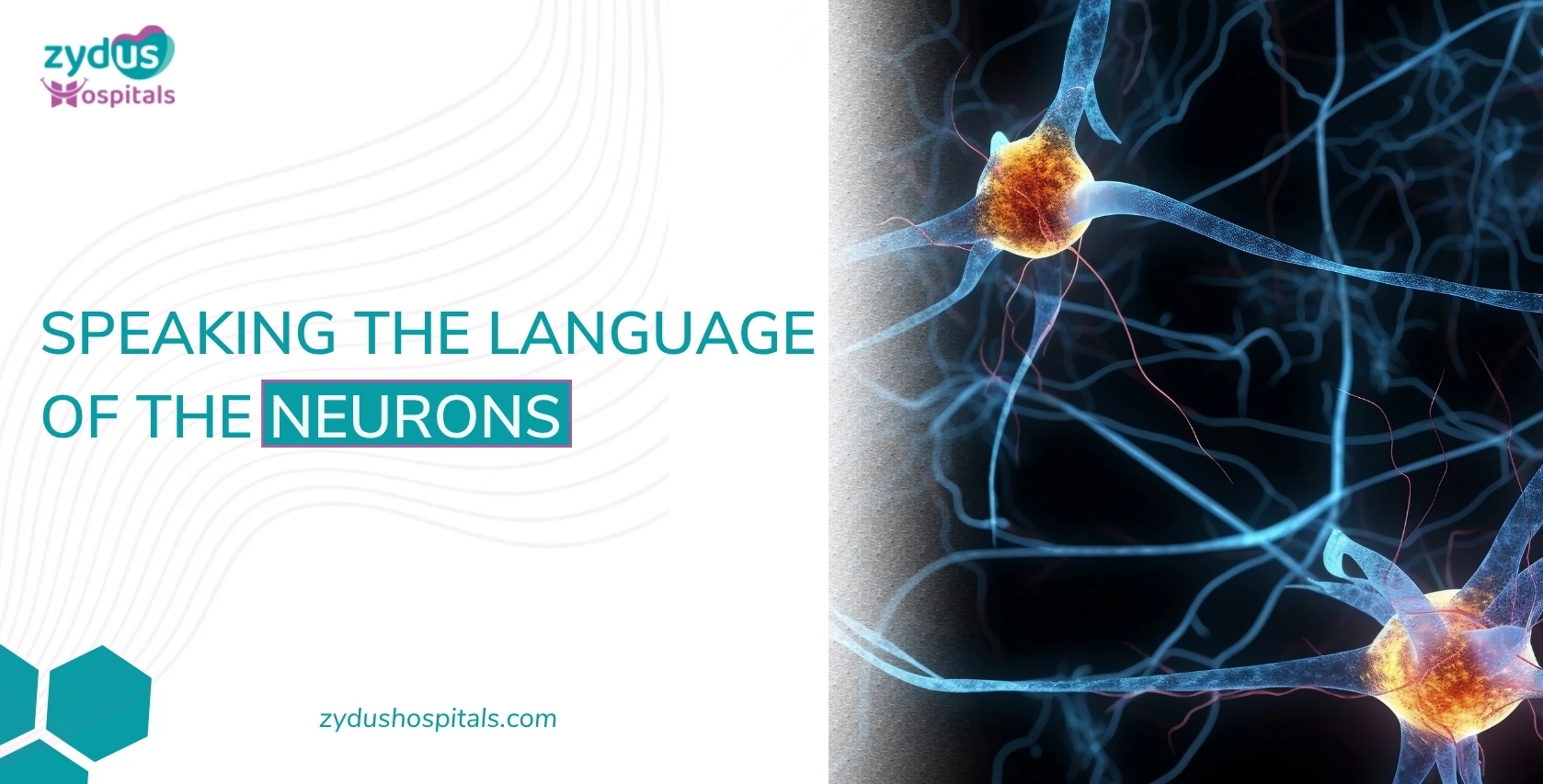
Speaking the Language of the Neurons
What is Deep Brain Stimulation (DBS)?
Picture a vinyl record with a deep scratch. Every time the needle hits it, the music skips. It doesn't matter how good the rest of the record is. That one faulty loop keeps repeating, over and over. Parkinson's disease does something similar to the brain. Specific circuits get stuck in an abnormal loop, firing too fast and out of rhythm, producing uncontrollable tremors and rigidity in limbs.
Now imagine if we could press a tiny, precise thumb onto the needle and stop the skip. That is, roughly, what deep brain stimulation does.
What is Happening Inside the Brain?
Deep inside the brain sits a cluster of structures called the basal ganglia, which acts like a set of relay stations that help coordinate movement. Normally, they function like a well-managed traffic system, letting the right signals through and suppressing the others.
However, in Parkinson's disease, the neurons that produce dopamine (a neurotransmitter essential for coordinating motor signalling) die off progressively. The loss of dopamine disrupts the normal activity of the basal ganglia network, leading to abnormal neuronal firing patterns and excessive synchronization within movement circuits. The downstream result is the hallmark symptoms of Parkinson's: tremor, rigidity, and a characteristic slow, shuffling gait.
In Dystonia, a related but distinct condition, basal ganglia circuit malfunction occurs in a different pattern, producing sustained or repetitive muscle contractions that cause involuntary movements in patients.
Deep brain stimulation works by correcting the disrupted circuit activity of the basal ganglia. An estimated 300,000 DBS surgeries have been done worldwide in the last two decades. The majority of Parkinson's disease, though this still represents a small fraction of the nearly 10 million people living with the condition globally.
The Accidental Discovery That Changed Everything
In 1987, French neurosurgeon Alim-Louis Benabid was performing a thalamotomy (a procedure to destroy a small portion of the thalamus to reduce tremor) when he made an unexpected observation. Before making the permanent lesion, he tested the tissue with electrical stimulation at varying frequencies while the patient lay awake and reported what they felt in real-time.
At low frequencies, around 10-50 Hz, the stimulation deteriorated symptoms. But at frequencies above 100 Hz, the tremors seemed to have stopped.
Benabid had discovered a way to mimic the benefit of a brain lesion without making one. His 1987 paper on thalamic stimulation for tremor marked a new era in functional neurosurgery.
A Timeline Of Milestones
1987
Benabid publishes the first thalamic DBS results for tremor, demonstrating that high-frequency stimulation can reversibly suppress symptoms.
1993
The subthalamic nucleus is identified as a key DBS target; stimulation is shown to improve all major motor symptoms of Parkinson's disease.
1997
The US FDA approves DBS for essential tremor
2002
The US FDA approves DBS for Parkinson's disease
2003
The US FDA approves DBS for Dystonia
2009
DBS received a Humanitarian Device Exemption from the FDA for severe treatment-resistant OCD, opening the door to mental health applications.
2018
The FDA has approved DBS for epilepsy
Feb 2025
Closed-loop, adaptive DBS technology approved as the first commercially available brain-computer interface (BCI) system. Although adaptive DBS is not universally considered a BCI.
What the Procedure Involves
DBS requires a dedicated multidisciplinary team: a neurosurgeon, a movement disorder neurologist, a psychiatrist, an anaesthesia specialist, and a physiotherapist. The procedure spans approximately three days from admission to discharge, and the treating hospital must be equipped with a modular operating theatre, in-house 3T MRI and CT imaging, neuronavigation, MER( microelectrode recording) capability, macro stimulation facility, O-arm, and rehabilitation department.
At Zydus Hospital, Ahmedabad and Vadodara, there are experts available who have specifically studied Movement Disorders and are offering excellent patient care across advanced neurology services. The number of DBS surgery procedures has also increased under the expertise of Dr Kalpesh Shah, Ahmedabad, along with the neuro teams at Ahmedabad and Vadodara. The teams also include Dr Dinesh Saini and Dr Suvorit Bhowmick, Neurologists and Parkinson's disease specialists, delivering stellar outcomes in Parkinson’s and other movement disorders.
In The Operating Room
Because the brain has no pain receptors, deep brain stimulation surgery is performed either awake or under general anaesthesia, depending on the centre’s protocols and patient factors. The patient's head is secured in a rigid stereotactic frame, a halo-like device that allows the surgical team to map the brain as a three-dimensional coordinate system and reach a target the size of a peppercorn with sub-millimetre precision. Target coordinates are calculated from preoperative MRI and refined with CT imaging on the day of surgery.
Ultra-thin wire electrodes, roughly 1.27 mm in diameter, are implanted into a precisely identified target deep within the brain. These are connected, via wires running beneath the skin, to a pulse generator implanted near the collarbone.
To confirm accurate placement, a technique called microelectrode recording is used. Every brain region has a characteristic electrical signature or a distinct electrical "voice". The substantia nigra crackles with a rapid, irregular pattern, and the subthalamic nucleus produces a dense, high-frequency pattern. Experienced surgeons can navigate which area of the brain they are in by sound alone. This real-time neural mapping allows the team to verify their position before the electrode is fixed in place. Once the placement is confirmed, the electrode is fixed in place. The full procedure typically takes five to six hours.
After Surgery
The DBS system is activated about 2 to 4 weeks after the procedure. Over the subsequent weeks, multiple stimulation parameters like frequency, pulse width, amplitude, and active electrode contacts are carefully adjusted to maximize benefits while minimising side-effects. The device continuously fires calibrated electrical pulses into the brain, disrupting the pathological pattern and allowing normal activity to resume.
The DBS system can work efficiently for over 5 to 6 years in a non-rechargeable battery. A rechargeable battery, which requires approximately two hours of charging per week, may last 15-25 years before replacement becomes necessary.
Applications of DBS
Parkinson's disease remains the primary indication. Deep brain stimulation Parkinsons treatment significantly extends the window of good motor control, reducing fluctuations and allowing meaningful reductions in medications.
Essential tremor, often dismissed, can be profoundly disabling. Severe ET makes handwriting illegible, drinking from a glass impossible, and causes many other problems. Thalamic DBS that targets the ventralis intermedius nucleus abolishes tremor in roughly 80-90% of patients, often immediately, making it an important essential tremor treatment option.
Obsessive-compulsive disorder became the first psychiatric application, approved for severe, treatment-resistant cases where medication and therapy have failed. The target is the anterior limb of the internal capsule, an area connecting the frontal cortex to deeper structures.
DBS is also being explored among the new treatments for dystonia, especially for patients who do not respond adequately to medication or botulinum toxin therapy.
Who is a Candidate?
DBS does not work for everyone, and candidacy is carefully assessed. Cognitive status, anatomy, disease subtype, and psychiatric history are all taken into account by experts.
The decision to proceed with DBS is complex and requires careful patient selection in idiopathic Parkinson disease, as not all individuals with Parkinsonism are suitable candidates. Patients with atypical Parkinson's disease, such as multiple system atrophy or progressive supranuclear palsy, may not respond as effectively to DBS.
Motor complications play a central role in determining eligibility. DBS is particularly effective for those experiencing severe motor fluctuations, dyskinesia, or medication-resistant tremor. The “5-2-1” criteria are often used as a practical guideline: patients requiring five or more daily doses of levodopa, experiencing at least two hours of “off” time per day, and enduring one or more hours of troublesome dyskinesia are strong candidates for DBS. These benchmarks highlight the inadequacy of medical therapy and the potential for surgical intervention to restore quality of life.
For essential tremor, a patient with a confirmed diagnosis after exclusion of other causes of tremor can go for DBS surgery for disabling tremor treatment. Candidates with severe tremor that interferes with daily activities such as eating, writing, or dressing, and who are refractory to medications are ideal candidates.
For dystonia, primary dystonia responds better to Deep Brain Stimulation (DBS) than secondary causes such as stroke or trauma. Candidates are typically those who have failed medical management and botulinum toxin therapy. Younger patients with shorter disease duration tend to derive the greatest benefit.
How Effective is DBS?
For patients who have spent decades imprisoned by the side effects of movement disorders, the results with DBS can be transformative.
Recent studies show that DBS achieves high success rates in movement disorders: around 60-70% improvement in Parkinson’s disease, 70-90% tremor reduction in essential tremor, and 50-70% sustained benefit in dystonia patients.
| Condition | Effectiveness | Safety Profile | Notes |
|---|---|---|---|
| Parkinson's Disease | High | Acceptable | FDA-approved, adaptive DBS promising |
| Essential Tremor | High | Acceptable | FDA-approved since 1997 |
| Epilepsy | Moderate-High | Acceptable | FDA-approved (2018) |
| Depression (TRD) | ~48% response | Acceptable | Limited by small trials |
| OCD | ~35% remission | Acceptable | Humanitarian Device Exemption |
| Tourette's Syndrome | >50% reduction | Acceptable | Strong symptom relief |
| Autism-related Aggression | >50% reduction | Acceptable | Early but promising |
| Robot-Assisted DBS | Comparable | Comparable | Accuracy ~1 mm, safe |
| Dystonia | Highly effective | High | Very accurate |
DBS Surgery in Gujarat: Zydus Hospitals
The DBS surgery programme at Zydus Hospital, Vadodara, has also successfully performed the surgery in several patients and has a strong track record for the treatment of Parkinson's disease, essential tremor treatment, and related movement disorders. Together, the two centres represent a significant leap forward in advanced neurology and functional neurosurgery services.
Our movement disorder specialists have trained at leading neuroscience centres across the world and bring their global expertise to ensure that patients across the country have access to what many consider among the best treatment for Parkinson's disease in India.
For patients searching online for what is deep brain stimulation, reliable care often depends less on flashy hospital marketing and more on whether the centre has the infrastructure, experience, and multidisciplinary expertise to manage the complexity of movement disorders properly.