Alzheimer’s Disease: Symptoms, Causes, Diagnosis and Treatment
A guide to memory changes and support for families
Reviewed and verified by the medical team at Zydus Hospitals.
Forgetting a name and remembering it later can happen to anyone. A repeated change is more concerning: asking the same question several times, losing track of familiar tasks or forgetting a conversation that happened just a few minutes ago. Families often notice these changes before the person recognises them.
Alzheimer’s disease is a progressive brain condition that affects memory, thinking and, over time, everyday independence. It is the most common type of dementia, but forgetfulness alone does not establish the diagnosis. A careful assessment helps identify the cause and the support a person needs.
Key message: Persistent or worsening memory changes deserve a medical evaluation. Alzheimer’s care includes diagnosis, appropriate treatment and support for the person and family. A blood-test result must be interpreted as part of that assessment.
Conceptual brain illustration from the Zydus Hospitals brochure. This is an illustration, not a diagnostic scan.
What is Alzheimer’s disease?
Alzheimer’s disease damages nerve cells and the connections that allow them to communicate. Changes involving beta-amyloid and tau proteins are important features of the disease. As more brain networks are affected, difficulties may extend from learning and remembering new information to language, judgement and daily activities.
Alzheimer’s is more common in older adults, but it is not an unavoidable part of ageing. It can also begin before 65, when it is called young-onset or early-onset Alzheimer’s disease. “Early-onset” describes the age at which symptoms begin; “early-stage” describes how far the illness has progressed.
Alzheimer’s disease and dementia are related but different
Dementia is an umbrella term for a group of conditions that cause a progressive decline in cognitive abilities, affecting memory, thinking, reasoning, language and the ability to perform everyday activities.
Alzheimer’s is one disease that can cause this decline. Other causes include vascular disease, dementia with Lewy bodies and frontotemporal dementia. More than one cause may be present in the same person. Identifying the likely cause matters because assessment and treatment can differ.
A diagnosis of mild cognitive impairment, or MCI, means that thinking or memory has changed more than expected while most everyday independence is preserved. MCI can have several causes, and it does not always progress to Alzheimer’s dementia.
Normal ageing or a change that needs assessment
| Everyday situation | Occasional lapse | Change worth discussing with a doctor |
|---|---|---|
| Remembering information | A forgotten name comes back later. | Recent conversations are repeatedly forgotten. |
| Managing everyday tasks | A task takes a little longer. | Bills, medicines or familiar cooking steps become difficult to manage. |
| Finding the way | A turn is missed in an unfamiliar area. | The person becomes lost on a familiar route. |
| Keeping track of belongings | An item is misplaced but found by retracing steps. | Items are repeatedly placed in unusual locations and cannot be traced. |
These examples help describe a pattern; they are not a home diagnostic test. The main concern is a persistent change from the person’s usual abilities, especially when it affects safety or independence.
Early Alzheimer’s symptoms families may notice
Difficulty retaining new information is a common early feature. Other changes may appear alongside memory problems, and some people have a less typical presentation. Watch for a pattern over time rather than interpreting one incident in isolation.
- Repeating questions without recalling that they were already answered.
- Missing appointments or forgetting recent events more often.
- Finding it harder to follow a conversation or choose familiar words.
- Struggling with planning, handling money or completing usual tasks.
- Becoming confused about dates, places or familiar surroundings.
- Showing changes in judgement, confidence, motivation or behaviour.
Older memories may remain clearer than recent ones. A person may also compensate with reminders, so difficulties can become more visible when routines change. Bring specific examples to a consultation rather than relying on a label such as “poor memory”.
Depression, poor sleep, medicine effects, thyroid problems and vitamin deficiencies can also affect memory or concentration. Some contributors are treatable and can coexist with Alzheimer’s disease. A consultation with the Neurology team at Zydus Hospitals can help clarify which assessment is appropriate.
What causes Alzheimer’s disease and who is at risk?
The full cause is not completely understood. Abnormal amyloid deposits and tau tangles are associated with injury to brain cells, but most cases arise through a combination of age, genetic susceptibility and other influences. A family history can raise risk without making the disease inevitable. Rare inherited forms are different and may warrant genetic counselling, particularly when several relatives developed symptoms at a young age.
Age is the strongest established risk factor. Other relevant factors include Down syndrome, previous significant head injury and cardiovascular risks such as high blood pressure, diabetes, smoking and high cholesterol. Hearing or vision loss, depression, poor sleep, inactivity and social isolation also deserve attention in a broader review of brain health. Having a risk factor does not mean that a person has Alzheimer’s disease.
Stages of Alzheimer’s disease
Changes in the brain may begin before symptoms become noticeable. When symptoms are present, clinicians assess both thinking skills and everyday function. The following stages describe broad care needs rather than a fixed timetable.
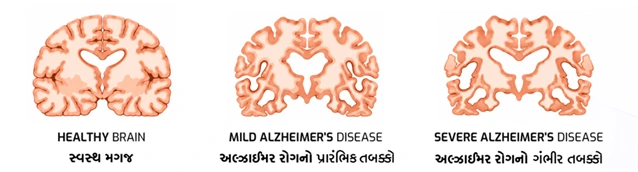
Illustration comparing a healthy brain with changes depicted in mild and severe Alzheimer’s disease. It cannot determine an individual’s diagnosis or stage.
| Clinical phase | What may change | Support that may be needed |
|---|---|---|
| MCI due to Alzheimer’s | Measurable cognitive change with most independence retained; evidence supports Alzheimer’s as the cause. | Follow-up, practical strategies and assessment of treatment eligibility. |
| Mild dementia | Memory or thinking problems interfere with complex tasks. | Help with finances, medicines, planning and safety decisions. |
| Moderate dementia | Confusion, communication problems or behaviour changes become more prominent. | Increasing assistance with dressing, meals and daily routines. |
| Severe dementia | Communication, mobility and swallowing may be affected. | Extensive personal care, nutrition support and attention to comfort. |
Progression varies and stages can overlap. A sudden deterioration needs assessment for other causes, such as infection, delirium, a medicine effect or stroke. It should not be assumed to be an ordinary progression.
How Alzheimer’s disease is diagnosed
Diagnosis begins with the history: what has changed, when it began and how it affects everyday life. With the person’s agreement where possible, a family member can add observations. The clinician reviews medical conditions, medicines, sleep, mood, hearing and vision, and performs a physical and neurological examination.
Memory and thinking assessments examine areas such as attention, language, recall and planning. Education, preferred language and sensory difficulties can affect performance, so a score must be interpreted in context. More detailed neuropsychological assessment may be useful when the pattern is unclear.
| Assessment or test | What it helps assess | Important distinction |
|---|---|---|
| Cognitive assessment | Memory, attention, language and other thinking abilities. | A score alone does not establish the cause. |
| Routine blood tests | Possible contributors such as thyroid or vitamin problems. | These differ from Alzheimer’s-specific biomarkers. |
| MRI or CT brain scan | Brain structure and other explanations, including vascular injury. | A structural scan is not the same as an amyloid test. |
| Blood biomarkers | Biological changes associated with Alzheimer’s. | Use depends on the assay and clinical situation. |
| CSF biomarkers or specialised PET | Further assessment of Alzheimer’s-related proteins or brain function. | Selected when the result can answer a clinical question. |
CSF means cerebrospinal fluid, which surrounds the brain and spinal cord and is collected by a lumbar puncture. PET stands for positron emission tomography, a specialised imaging test. Not everyone needs every test. A neurologist chooses investigations according to the symptom pattern and considers the results together.
A blood test is now also available to support the assessment of Alzheimer’s disease. The details follow.
Now Alzheimer Blood test, at Zydus
Zydus Hospitals, Ahmedabad, in collaboration with Agappe, offers blood-based biomarker testing to support the assessment of Alzheimer’s disease.
The test measures the pTau217/amyloid beta 1–42 ratio and is prescribed by a neurologist for people with relevant symptoms. Results are interpreted alongside clinical history, memory and thinking assessments, and other investigations needed to guide care.

Laboratory analyser shown in Zydus’s educational video. Illustrative visual.
For the first visit, bring a list of medicines, previous reports and a few examples of the changes noticed at home. If the person is comfortable, a family member who knows their daily routine can attend. Note when the changes began and whether there have been problems with sleep, mood, medicines or everyday safety.
You can view Zydus doctors in Ahmedabad when planning an assessment. For information about arranging a Memory Clinic or neurology consultation, contact Zydus Hospitals.
Treatment and ongoing care
There is currently no cure that reverses Alzheimer’s disease. Treatment can help manage symptoms, support day-to-day function and, in selected patients, slow clinical decline. The plan depends on the diagnosis, stage, other illnesses and the person’s priorities. A neurologist will explain which treatment options are suitable after a full assessment.
Supporting someone with Alzheimer’s at home
Begin with what the person can still do. Support should make daily life safer while preserving choice and dignity. A familiar task may remain manageable when it is broken into smaller steps or done with a little assistance.
- Speak calmly, use one question at a time and allow time for a response. Reduce background noise during conversations.
- Use predictable routines and visible reminders. Keep important objects in the same place.
- Review medicines, cooking, finances, falls and driving with the care team. Arrange supervision according to actual needs.
- Include familiar music, gentle activity and enjoyable social contact without turning every activity into a memory test.
- Share caregiving duties and plan breaks. Ask for help when sleep, stress or exhaustion affects the caregiver’s health.
Persistent anxiety, low mood or difficulty coping may benefit from professional support. Psychology services at Zydus Hospitals can be discussed with the treating team when emotional or behavioural concerns need additional assessment.
Can Alzheimer’s disease be prevented?
No lifestyle measure can guarantee prevention. Looking after cardiovascular and general health may help reduce dementia risk and remains worthwhile at every age. Work with a clinician to manage blood pressure, diabetes and cholesterol; avoid smoking; keep alcohol low; and maintain physical activity suited to your health.
A balanced diet, attention to hearing and vision, and continued social and mentally engaging activities can support wellbeing. Seek assessment for persistent sleep or mood problems. Brain games and supplements should not be presented as proven ways to prevent or cure Alzheimer’s disease.
When to arrange an assessment and when to seek urgent care
Arrange a consultation when memory or thinking changes persist, worsen or interfere with usual activities. You do not need to wait until independence is substantially affected. An earlier assessment may identify treatable contributors and gives the person and family time to understand the options.
Seek urgent medical care for sudden confusion, reduced alertness or a rapid change over hours or days. Sudden facial drooping, one-sided weakness, speech difficulty or loss of vision can indicate a stroke. Even someone already diagnosed with Alzheimer’s needs urgent assessment for a new, sudden change.
Memory assessment and Alzheimer’s care at Zydus Hospitals
The Zydus Memory Clinic in Ahmedabad brings together neurologists, psychiatry and neuropsychology expertise for the evaluation, diagnosis, treatment and management of memory-related conditions. The purpose is to understand the pattern of change and guide the next step for the individual and family.
Concerned about persistent memory changes? Find a Zydus doctor and request an appointment.
Common questions about Alzheimer’s disease
What is usually the first sign of Alzheimer’s?
Difficulty remembering recent information is common, such as repeatedly forgetting a recent conversation. The first noticeable change can vary, and isolated forgetfulness is not enough to diagnose the disease.
Can younger adults develop Alzheimer’s?
Yes. Symptoms beginning before 65 are described as young-onset Alzheimer’s disease. Memory problems in younger adults can have many other causes, so a proper assessment is essential.
Does a blood test replace a brain scan?
Not automatically. A blood biomarker and a structural brain scan answer different questions. A neurologist decides whether a validated biomarker can reduce the need for other investigations or whether further imaging or CSF testing is needed.
Is an Alzheimer’s blood test suitable for everyone?
No. It should be considered within an appropriate clinical assessment. The test discussed here is not a routine screening recommendation for people without symptoms.
Is Alzheimer’s hereditary?
Genes can influence risk, but most cases are not caused by a single inherited gene. A strong family history, particularly with young-onset disease, is a reason to discuss genetic counselling rather than order a genetic test independently.
Can Alzheimer’s treatment restore memory?
Current treatment cannot reverse the disease or reliably restore lost memories. Medicines may help symptoms, and certain newer therapies can slow decline in selected early cases. Practical support remains part of care at every stage.
Is mild cognitive impairment the same as Alzheimer’s?
No. MCI describes a level of cognitive change, and there are several possible causes. Only an appropriate evaluation can establish whether Alzheimer’s-related changes are likely to be responsible.
Which doctor should assess memory problems?
A physician or neurologist can begin the assessment. A memory clinic can coordinate more detailed evaluation when needed. Sudden confusion or other sudden neurological symptoms should be assessed urgently.
Medical information note: This article provides general health information and does not replace an individual medical assessment. Diagnosis, investigations and treatment should be discussed with a qualified healthcare professional.